The game
You are the doctor Enamel Town was waiting for
Patients arrive. Something is visibly wrong with each of them. You have a tray of cures, a room that fills up, and as long as it takes to look properly.
A shift, start to finish
A shift is one round in one place on the map. Patients walk in, wander the floor, and wait for you.
- Look. Every sick patient is drawn with their symptoms on show.
- Decide. Match what you can see against what the cures do.
- Pick a cure from the tray at the bottom of the screen.
- Tap the patient. Right cure, and they are cured and cheer.
- Keep the room from tipping. Sick patients spread to healthy ones standing near them.
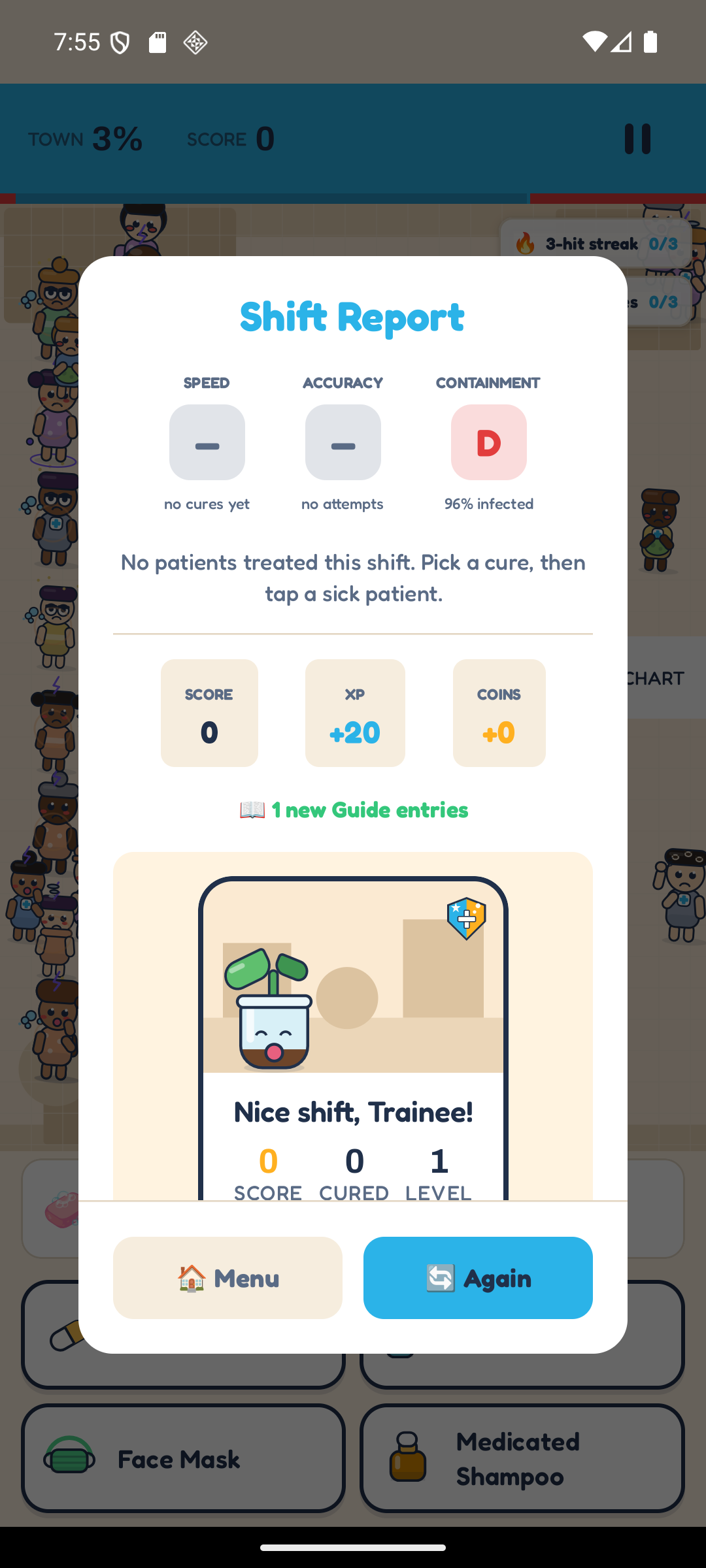
The shift ends when the waiting room runs out of chairs. Then the Shift Report grades what happened.
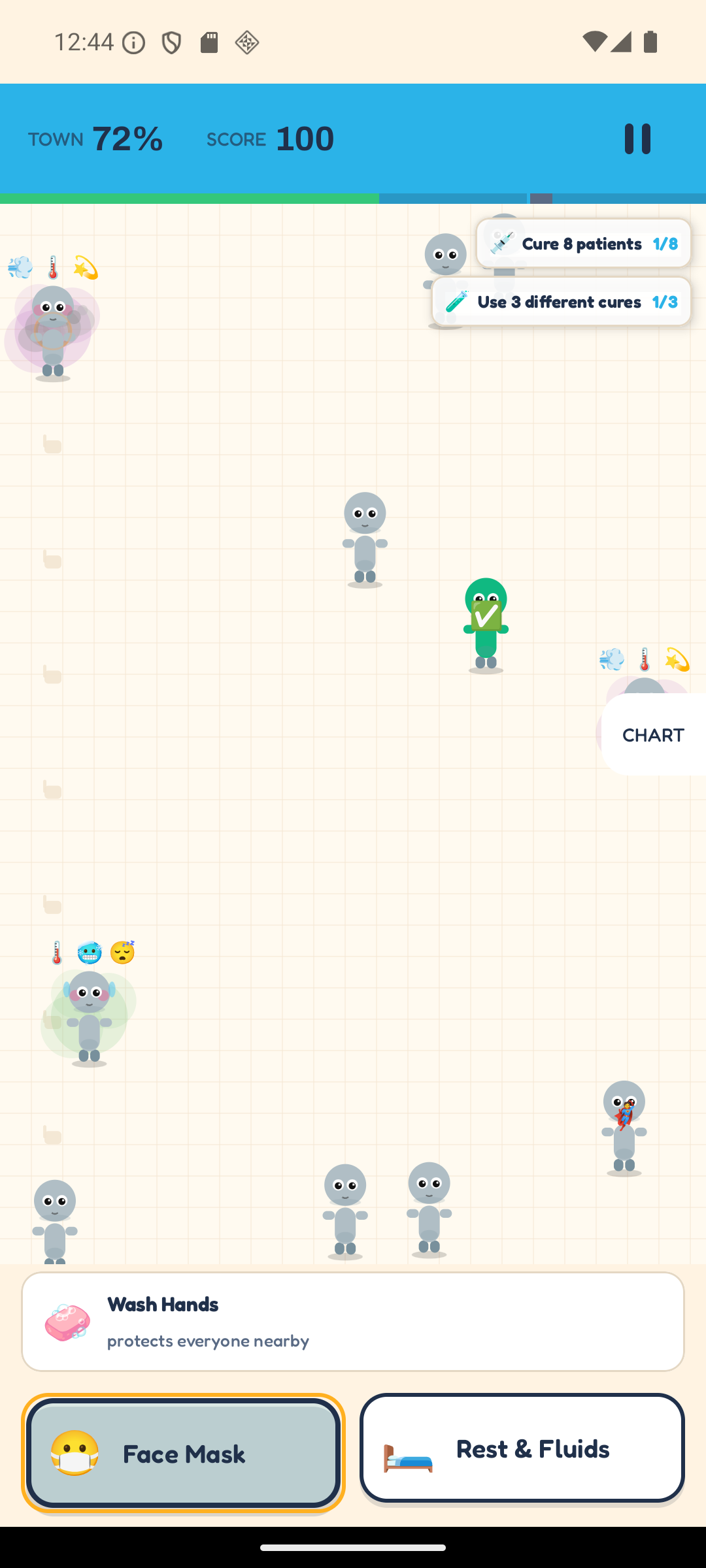
Symptoms are the puzzle
Twelve illnesses appear in the game. Each one is a costume of visible signs rather than a number hidden in a tooltip.
A primary sign you cannot miss
Full-size, fully outlined, and the only sign allowed to animate. Spots on the torso. Enormous pink eyes. A green belly and two hands holding it.
Quieter second and third signs
Drawn smaller and still, for the player who looks longer: a flushed cheek, a scratch, an ache bolt, a cough cloud.
Signs that survive shrinking
When a patient is drawn small, the extra detail drops away and the primary sign plus a small diagnosis pip remain, so a crowded room stays fair.
Two illnesses that must never blur
Chickenpox and measles both put spots on the torso. They are deliberately pulled apart by a second, non-colour difference: chickenpox keeps a strong scratching posture, measles keeps clearly reddened eyes. A player who cannot tell colours apart can still tell these two apart.
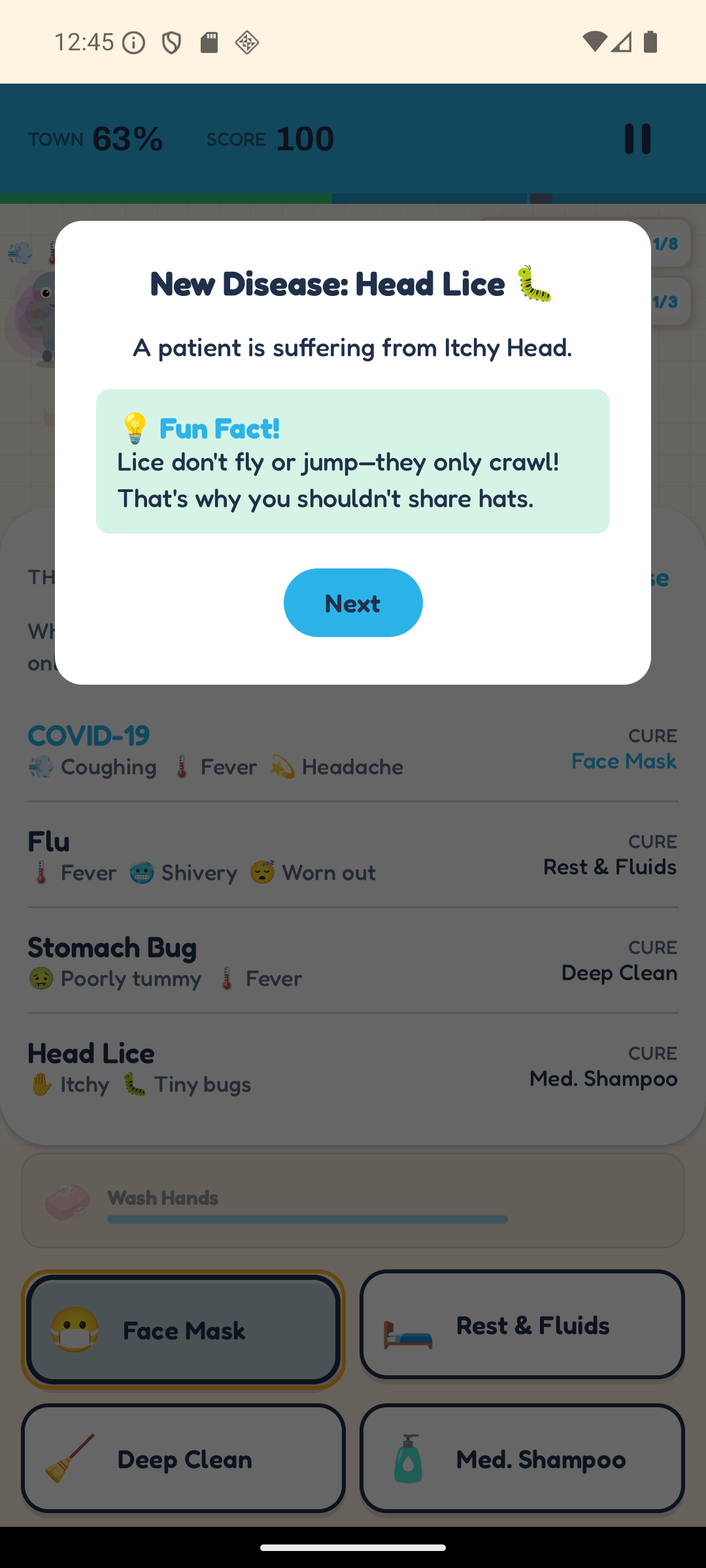
Choosing the cure
Twelve cures sit in the tray, and they are not interchangeable. They fall into four kinds, and the icons are drawn so that the kind reads at a glance.
| Tool | Used on a patient directly |
|---|---|
| Treatment | Treats the illness itself |
| Shield | Protects against catching it |
| Care | Supports recovery |
A shield does not cure. The face mask stops spread and never claims to cure anything. The distinction is a rule of the game, not a detail of the art.
Not sure what is in front of you? The Chart tab pulls up a sheet listing the illnesses that can appear in this place and the signs that identify them. It is always available, mid-shift, at no cost.
Pressure you can see
Spread is drawn on the floor
A contagious patient carries a visible radius. A healthy patient standing inside it fills an exposure meter, and that meter drains as soon as they move away. Curing the last carrier near someone empties their meter entirely and counts as a save.
Nothing catches by invisible dice roll. If someone is about to get sick, you could have seen it coming and you could have stopped it.
The waiting room is the clock
Ignore a patient long enough and they get tired, stop wandering, stop spreading — and take a chair. There are eight chairs to start with. When the last one goes, the shift is over.
So there are always two clocks running against each other: the contagious patient about to infect three people, and the tired one about to take your last seat.
What a shift leaves behind
The Shift Report grades three things — Speed, Accuracy and Containment — and then hands over the takings.
- Score for the run itself.
- XP toward the next level, which opens new places on the map.
- Coins to spend on the clinic.
- Mastery in each illness you treated, tracked separately.
- Doctor's Guide discoveries — new illness, cure, citizen, badge or theme cards.
- Daily goals and Sprout's current ask.
- A postcard: a keepsake picture of the run, with its score.
Liked a particular clinic? Every shift has a nine-character shift code. Type a friend's code on the home screen and you get their exact clinic — same place, same patients, same order. It works offline and needs no account.
Ways to make it easier
Three options sit in Settings, under Easier to play. None of them hides anything, and none of them is a lesser version of the game.
Reduced motion
Warning rings and markers stop pulsing. Nothing is hidden — the same information is still on screen, it simply holds still.
Calm Clinic
Illness spreads about a third as fast, so there is time to think. The puzzle is unchanged; only the clock slows down.
Name the symptoms
Patient charts spell out each symptom in words instead of showing only a picture, for players who would rather read than decode.
Sound effects, music and haptics each have their own switch. The game also follows the device's own text size, and has been checked at 200 per cent.
A word about what this game is
Freeze or Sneeze is a work of fiction. Its illnesses, symptoms and cures are simplified and stylised to make a fair puzzle, not to describe real medicine. It does not teach diagnosis and it is not a health tool.
This is a game, not medical advice. If you feel unwell, tell a grown-up.
The same line appears in the game: once as a gate the first time it is opened, and permanently at the foot of the Doctor's Guide.